Five business stories that moved consumer India in the last 48 hours.
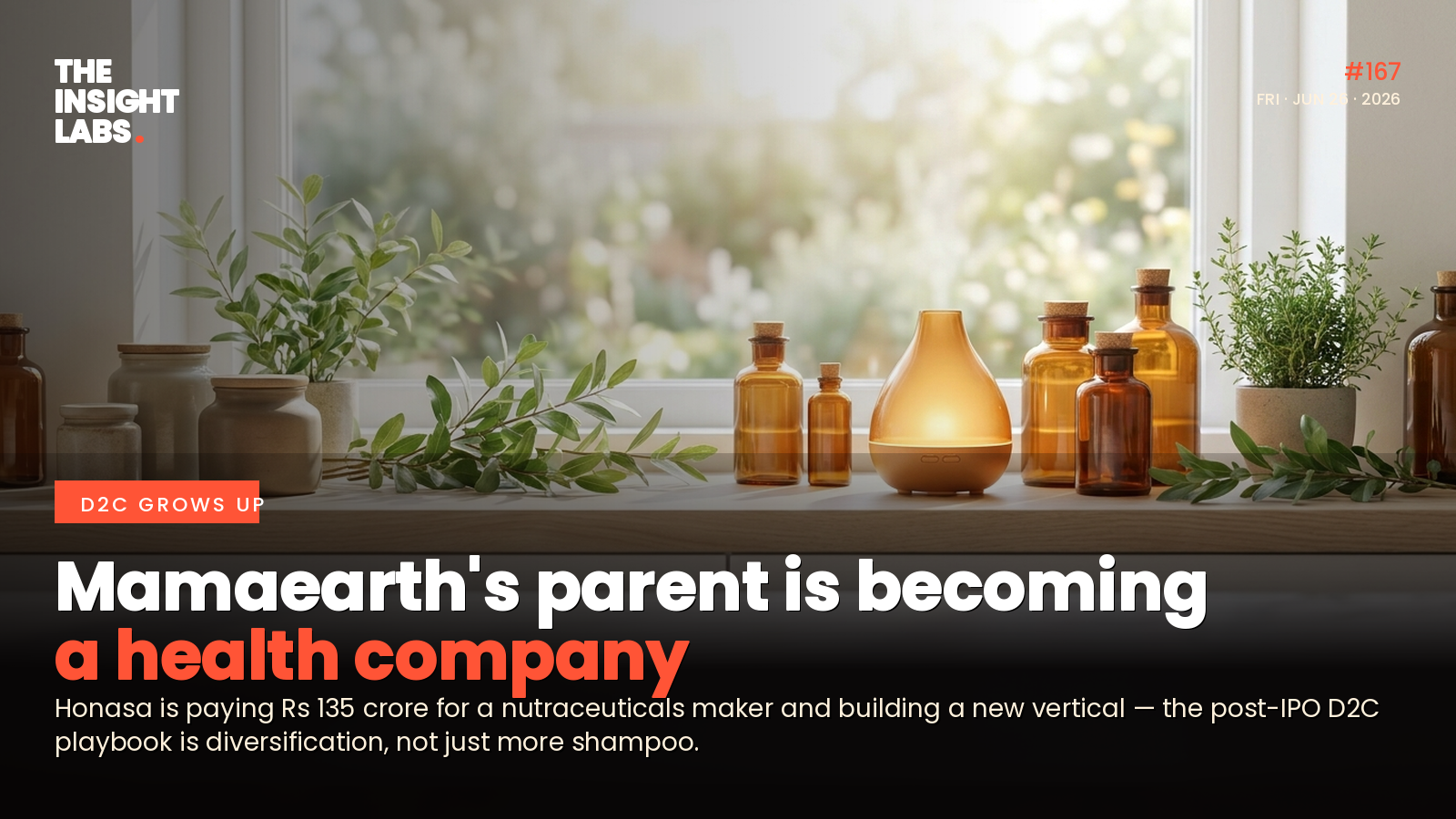
Mamaearth’s parent is quietly building a health company
On June 24, Honasa Consumer — the parent of Mamaearth — approved buying a 58% stake in nutraceuticals maker Fluence Pharma for about Rs 135 crore, and is setting up a new subsidiary, Honasa Health, to build a supplements business end to end (StartupTalky). Fluence sells condition-specific OTC kits through 3,000-plus dermatologists. Honasa posted Rs 200 crore of net profit in FY26, up 175%, and is steering toward Rs 5,500 crore by FY31 under its Honasa 3.0 plan. The read: a digital-first beauty brand that had a bruising first listed year has stopped betting on one hero product and is becoming a house of consumer-health brands.
A 28-year-old salon chain raises money for the first time in nine years
Bengaluru’s Bodycraft, a beauty and wellness chain founded in 1997, raised Rs 120 crore in a Series A led by Singularity AMC — its first major outside capital since a Rs 18 crore round in 2017 (StartupTalky). It runs 67 outlets (33 clinics, 34 salons) across 10-plus cities and will add 30 locations and clinical technology. India’s clinical aesthetics market is projected to grow from $2 billion in 2024 to over $7 billion by 2033. The cheque is chasing the shift from grooming to clinical — treatments the D2C creams can’t deliver online, where the pricing power is real.
An Indian software firm buys AI to keep its customers from leaving
MoEngage, the Bengaluru-founded customer-engagement platform, has acquired San Francisco AI startup Aampe for an undisclosed sum (StartupTalky). Aampe assigns an autonomous agent to each user to decide what to send, when and on which channel — more than 200 billion decisions a week for clients like Grab and Swiggy. MoEngage closed a $280 million Series F in late 2025 and is spending part of it to move from rules-based marketing to agents that act on their own. Buying the reinforcement-learning stack is faster than building it while the window is open.
Carmakers raise sticker prices while quietly discounting to clear the lot
From June, Maruti Suzuki and Hyundai lifted prices on select models by up to Rs 30,000, citing input costs — while Mahindra is dangling benefits of up to Rs 2.85 lakh on select SUVs (Autocar India, Cars24). On its volume XUV 3XO, total benefits run Rs 30,000-70,000 by variant. Mahindra’s domestic SUV sales rose 10.7% year on year in May to 58,021 units: still growth, but soft enough to need discounts. A list-price hike protects margin on paper; the discount is where real demand shows up — and both moving together says volume is harder to come by than the headline lets on.
Flipkart’s 10-minute arm crosses 1,000 stores, mostly outside the metros
Flipkart Minutes reached 1,000 fulfilment stores across 130 cities on June 24, roughly five times its footprint a year ago, adding about 100 stores a month (Business Standard). Around 90 of those 130 cities are Tier 2 and Tier 3, where average order values beat the metros. It still trails Blinkit’s 2,243 stores, Instamart’s 1,143 and Zepto’s 1,139 — but it is the only one of the four whose parent already owns the customer. The dark-store race has moved past the saturated metros into smaller cities, where the next wave of shoppers lives and one well-stocked store faces less competition.
Reply and tell us which of these you’d want a full teardown on.
— Satyam · The Insight Labs